
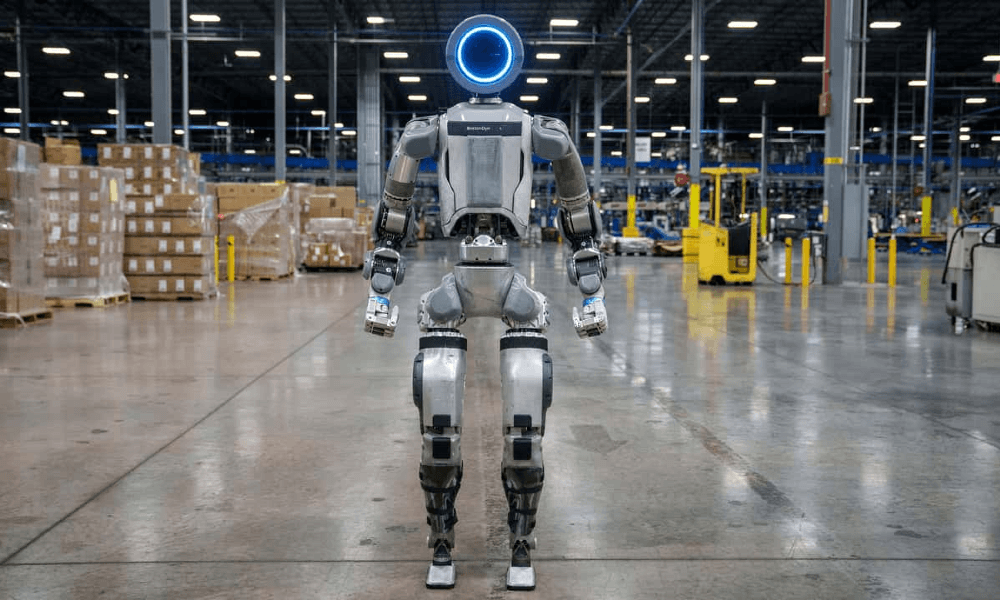
Hyundai is quietly trying to build the workforce that builds the cars, and that workforce happens to be made of metal, motors, and machine learning.
- Hyundai plans to order tens of thousands of Boston Dynamics robots over the next few years
- Atlas humanoids head to a Georgia plant in 2028, scaling to 30,000 units a year
- The shift could reshape factory quality, vehicle reliability, and resale value
A $21 Billion Bet on Robot Labor
The pieces have been falling into place for a while. Hyundai Motor Group acquired Boston Dynamics in 2021 for $1.1 billion, scooping up the company famous for those viral videos of dancing robot dogs and backflipping humanoids. Then last year, the automaker turned the partnership into something far bigger. Hyundai Motor Group announced it will invest $21 billion in the U.S., including a $6 billion push to drive new ideas and expand partnerships with American companies.
Part of that money is earmarked for hardware that doesn’t punch a time clock. As part of the investment, the Group will purchase tens of thousands of robots over the next few years. It will also fold Boston Dynamics into its broader manufacturing operation to help the company become the world’s top maker of advanced mobile robots.
Atlas Heads to the Factory Floor
At CES 2026, Hyundai laid out the timeline. The roadmap includes plans to build 30,000 Atlas humanoid robots a year by 2028 at its sprawling “Metaplant” near Savannah, and then put them to work in factories and warehouses worldwide. They’ll be deployed gradually, starting in 2028 at the Savannah plant, where Hyundai builds electric and hybrid vehicles like the Ioniq 5 and Ioniq 9.
The early jobs won’t be glamorous. Atlas will focus on parts sequencing, making sure vehicle components land in the correct spots on the line when they’re needed. The company said that by 2030 it will start using Atlas for more complex tasks, including component assembly, and eventually for jobs that involve repetitive motions or heavy lifting.
Spot, the four-legged robot dog, is already on the clock. You can spot Spot inspecting vehicles on the assembly line at Hyundai Motor Group Metaplant America. Atlas brings the next leap forward, a humanoid that can charge itself and keep working. It runs at a steady pace and doesn’t need to stop when its battery runs low. It just walks itself over to a charging station, swaps out its own batteries, and gets right back to it.
Why Quality Control May Be the Real Story
Manufacturers love consistency, and robots are nothing if not consistent. Once a single Atlas learns a new task, that task can be copied across the entire fleet. Train one, and the rest already know. That’s a big deal for catching defects early and keeping tolerances tight on every car that rolls off the line.
The ripple effect on consumers could be huge. Better quality control at the plant means fewer warranty claims, fewer recalls, and stronger long-term durability. As automakers like Hyundai pour money into robotics, the impact will likely be felt beyond new vehicle production, shaping everything from factory floor inspections to the long-term reliability of certified pre-owned cars that depend on rigorous build standards holding up over years of driving.
The Race Is Crowded and Getting Tense
Hyundai isn’t alone in this. Tesla plans to reveal the latest version of its Optimus robot in February or March, with production slated to begin by the end of 2026. Mercedes-Benz bought a stake in robotics firm Apptronik and is testing its robots in a couple of its German factories. BMW has been trying out Figure AI’s humanoid robots at its Spartanburg, South Carolina plant.
The competition has reportedly cranked up the heat inside Boston Dynamics. Former employees say Hyundai is pressuring Boston Dynamics to produce “tens of thousands” of robots in the next few years for its automotive plants. The catch? Boston Dynamics is reportedly making just four Atlas robots per month as it figures out how to ramp up large-scale manufacturing. That’s a long climb to 30,000 a year, and it has reportedly contributed to executive shake-ups inside the company.
What Drivers Should Watch For Next
If Hyundai pulls this off, the practical effects will roll out slowly but steadily. Expect tighter assembly tolerances on Ioniq EVs first, followed by similar gains across Kia and Genesis lineups. On the manufacturing side, Hyundai said it will use its Hyundai Mobis auto parts arm and Hyundai Glovis logistics firm to build an end-to-end robotics value chain that can churn out 30,000 robots a year.
For everyday buyers, the takeaway is simple. The car you drive in 2030 may share a factory floor with a thousand humanoid coworkers, and the quality of the welds, the panel gaps, and the wiring harnesses inside it might owe a quiet thank-you to a machine that never gets tired, never calls out sick, and never stops learning.