
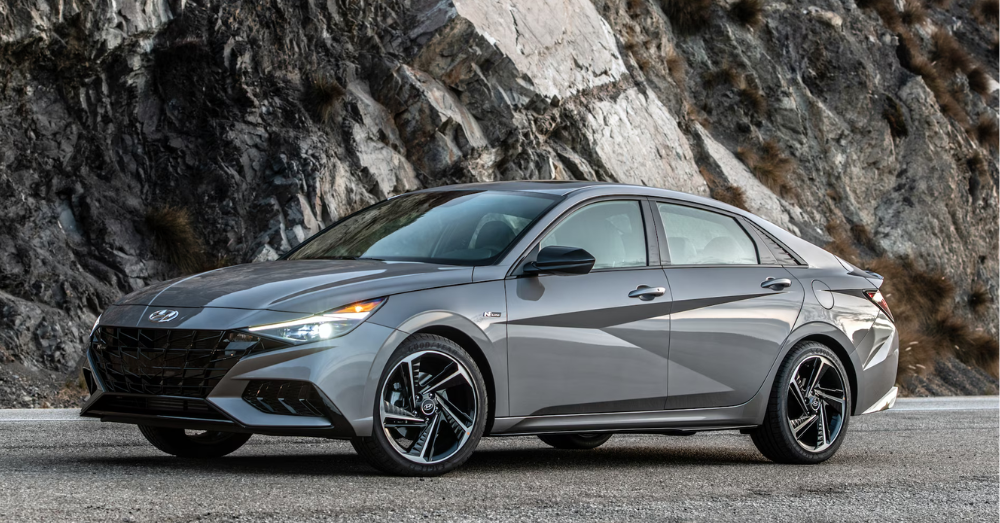
Hyundai’s compact Elantra has been around for a few decades and has seen several updates and changes. Let’s take a quick look at the generational history of the Hyundai Elantra, and see why it remains among the most popular used cars to buy.
7 Generations of Efficiency
First Generation (1990-1994)
Hyundai first launched the Elantra in 1990, replacing the poor-performing Hyundai Stellar. Designed to compete with established compacts like the Ford Escort and Chevrolet Cavalier, the little Elantra had its work cut out for it. Powering the Elantra was a Mitsubishi 1.6-liter I4, with a standard manual transmission or optional automatic. Hyundai gave the Elantra a facelift for the 1993 model year, along with a more powerful 1.8-liter Mitsubishi I4.
Second Generation (1995-1999)
The second generation saw the Elantra gain a station wagon version along with a pair of new engines, a 1.5-liter I4 and a 1.8-liter I4. The second generation was given a facelift in 1998 and received a new 2.0-liter I4 engine option. A 1.9-liter diesel motor was offered in European markets to help conform with new European Union emissions standards.
Third Generation (2000-2005)
The Elantra saw a surge in popularity starting with its third generation. Front and front-side airbags were now standard equipment, drastically increasing occupant safety. Only a 2.0-liter I4 was available for third-gen Elantras. To simplify dealer inventories, all United States-bound Elantras received power locks, power windows, air conditioning, and power steering. The Elantra GT came out in 2001 featuring stiffer suspension, leather, alloy wheels, and a spoiler. A facelift came along in 2004, with the major change being the rear-end design.
Fourth Generation (2006-2009)
Hyundai released the fourth-gen Elantra in 2006, featuring “coke bottle styling” meaning a narrow body with flared fenders. 1.6-liter and 2.0-liter I4 engines were offered, along with a new CVT transmission and a five-speed manual. Safety took precedence once again with the Elantra earning an overall Good rating from the IIHS, no small feat for a compact. Trims offered were GLS and SE, along with a Limited trim which was dropped in 2008. No facelift was given for the fourth-generation Elantra.
Fifth Generation (2010-2015)
2010 saw the fifth-gen Elantra’s introduction. A complete design modernization was undertaken, and Hyundai saw immediate sales increases. A new 1.8-liter I4 engine was introduced, along with either a six-speed auto or manual transmission. The CVT automatic from gen-four was dropped. Gen-five saw only two trim levels, GLS and Limited. A facelift occurred in 2014, seeing a slight change in design and the GLS trim’s name changing to SE.
Sixth Generation (2016-2020)
A new sloping fastback-inspired design debuted with the sixth-gen Elantra. The Elantra also underwent a growth spurt, now being classified as a mid-size sedan by the EPA. A 2.0-liter I4 engine was standard except on the new ECO Trim, which received a smaller 1.4-liter turbocharged motor. The Elantra Sport debuted in 2017, receiving a unique 1.6-liter turbocharged motor. No facelift was given in the US market for the sixth-gen.
Seventh Generation (2021-Present)
Presently, the Elantra is in its seventh generation. A radical new design, the Elantra received a larger sports sedan-inspired look. A myriad of safety features came along under Hyundai’s Smart Sense safety feature umbrella. Elantra won North American Car of the Year in 2021, and the seventh-gen was the first Elantra not offered in Western Europe for the first time. The performance-oriented 276-horsepower Elantra N-Line was introduced in 2021, with the Elantra receiving a facelift in 2023.
Whether it’s a first-gen or seventh-gen, the Elantra has always been a great choice for practical and economical motoring and is one of the best options for used cars on the market. Which generation do you like best?