
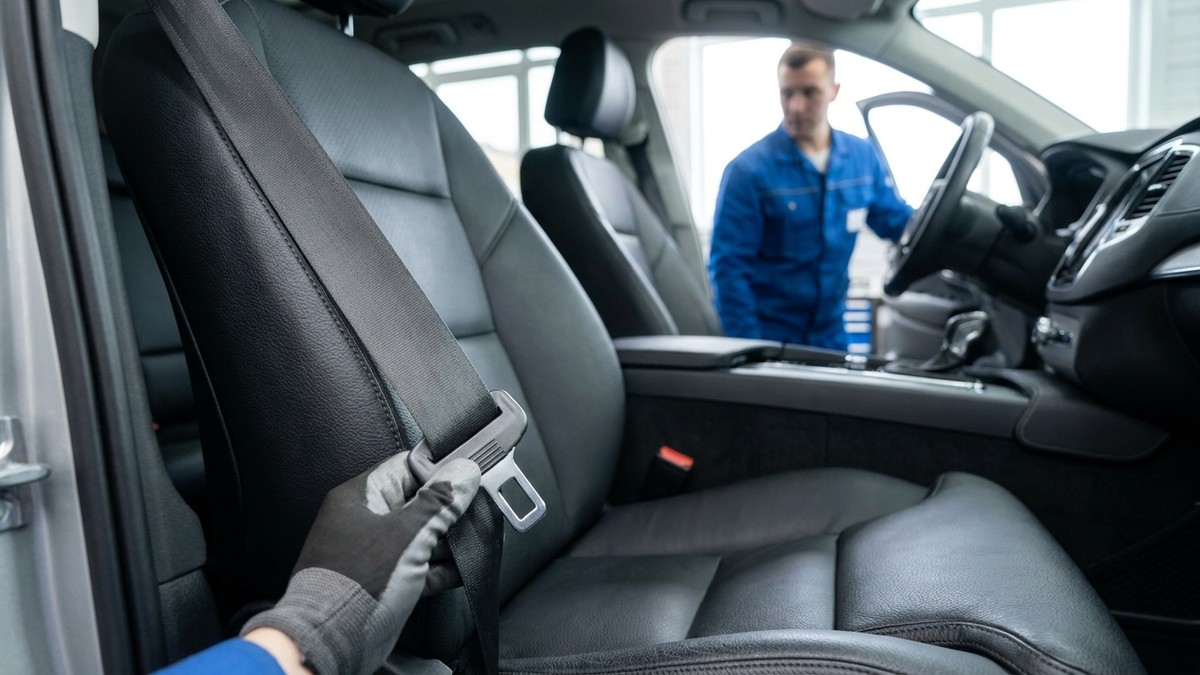
A seat belt only does its job if it lets you buckle in, and Kia just found a batch of new Tellurides where the driver’s belt might refuse to cooperate. The company is calling more than 6,000 SUVs back to dealers over a retractor that can lock up before you even get the strap across your chest.
- The recall covers 6,264 2027 Kia Telluride and Telluride Hybrid SUVs built in spring 2026.
- The driver’s seat belt retractor can lock early, stopping the webbing from extending.
- Dealers will swap the seat belt assembly for free, with owner letters going out July 31.
What Actually Goes Wrong
Every seat belt has a part called an emergency locking retractor, or ELR. In normal use it lets the webbing pull out smoothly when you reach for the belt, then clamps down hard the moment there’s a sudden stop or hard braking. That clamping is the whole point. It keeps you pinned in place during a crash instead of flying forward. Readers interested in the broader context can also explore how Kia SUVs compare.
On the affected Tellurides, that retractor can lock at the wrong time. When the driver tries to pull the belt out to buckle up, the mechanism seizes and the strap won’t extend. If you can’t pull the belt across your body, you can’t fasten it, and a driver who ends up riding unbelted faces a much higher chance of getting hurt in a collision. Federal safety regulators warn that an unavailable restraint raises the injury risk for an unbelted driver.
Which SUVs Are Affected
The recall reaches 6,264 vehicles in total, and all of them are 2027 model-year Tellurides. That breaks down into 4,367 Telluride Hybrid models built between March 24 and May 12, 2026, plus 1,897 gas-powered Tellurides built between March 24 and May 10, 2026. If your SUV rolled off the line outside those windows, it isn’t part of this action. For authoritative background, the NHTSA recall lookup offers useful context.
Kia traced the fault back to one of its suppliers, which installed an incorrect vehicle sensor in certain driver seat belt assemblies. NHTSA classified it as a supplier error. Because of that faulty part, the involved vehicles don’t meet Federal Motor Vehicle Safety Standard No. 209, the rule that governs seat belt assemblies. No other Kia models use the same defective retractor, so this stays contained to a specific run of Tellurides.
Here’s a reassuring detail. NHTSA estimates only about 1% of the recalled vehicles actually have the defect. That means the vast majority of owners probably have a belt that works exactly as it should. Kia is still pulling in the full batch because there’s no easy way to know from the driver’s seat which cars carry the bad sensor.
What Owners Should Do Now
The fix is simple and it won’t cost you a dime. Affected owners can bring their Telluride to a Kia dealer, and the dealer will replace the seat belt assembly at no charge. Kia is tracking this under recall number SC372, so keep that handy if you call ahead to schedule service.
Owner notification letters are set to go out on July 31. If you’d rather not wait for the mail, the Vehicle Identification Numbers tied to this recall became searchable on NHTSA.gov starting June 16, 2026. Punch your VIN into the agency’s recall lookup and you’ll know right away whether your SUV is on the list.
In the meantime, pay attention to how your driver’s belt behaves. If it ever resists coming out or feels like it’s catching before you can buckle, treat that as a red flag and get it checked. A belt that fights you when you try to put it on is telling you something, and it’s worth a quick trip to the dealer.
The Smart Move Before Your Next Drive
Recalls sound alarming, but this one has a clean path to resolution. The odds that any single Telluride is affected are low, the repair is free, and Kia caught it before it became a widespread problem. Run your VIN through the NHTSA site, watch for that notification letter, and book a dealer visit if your SUV shows up. A working seat belt is the cheapest safety feature you own, and keeping this one honest takes almost no effort on your part.