
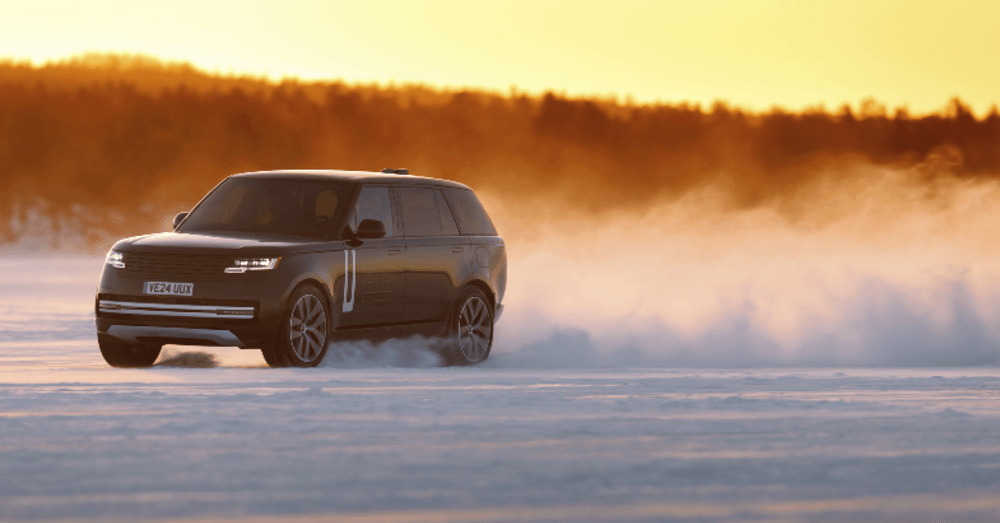
Sixty miles south of the Arctic Circle, in a Swedish town that turns into a giant frozen test track every winter, Land Rover is putting the finishing touches on its first true electric vehicle. The prototype rides on snow, glides across frozen lakes, and somehow still feels like a Range Rover. After spending time with the camouflaged mule, it’s clear the Brits are taking a measured approach rather than chasing spec-sheet bragging rights.
- Hits U.S. dealers in 2026 as a 2027 model year, expected to start around $170,000
- 117 kWh in-house 800-volt battery with a Land Rover target of over 300 miles of range
- 542 horsepower, 627 lb-ft, dual motors, and air suspension that still loves off-road work
Why Arjeplog Matters
If you want to see the biggest concentration of prototype cars in the world, head to the Swedish town of Arjeplog in the winter months. About 60 miles south of the Arctic Circle, it’s where many of the world’s automakers gather to test future vehicles in extreme conditions. Land Rover invited journalists out to ride along, and the program marks the second cold-weather development cycle for the EV. Engineers have racked up roughly 45,000 miles of accumulated testing across frozen lakes and land tracks, putting the thermal management system through a demanding schedule.
The cold matters because Range Rovers tend to live in cold places. A lot of time and money has been spent making sure the battery can deliver decent range in freezing conditions, recognizing that many Range Rovers live in the snowbelt. The headline piece of tech is ThermAssist, which helps cut heating energy consumption by up to 40 per cent.
The Numbers Under the Skin
Specs are competitive without being theatrical. There are two electric motors, one at the front and one at the rear, giving the EV all-wheel drive. The Range Rover produces 542 horsepower and 627 lb-ft of torque, which isn’t class-leading in EV terms but still delivers a healthy turn of pace. The battery has 117 kWh of capacity, again competitive rather than exceptional. Land Rover is targeting over 300 miles of range on a single charge.
JLR designed and built the 117 kWh 800V battery in-house, a first for the company, using a double-stacked, prismatic cell configuration. On the charging side, the 800V architecture supports DC fast charging up to 350 kW, which should make 10-to-80 percent stops painless on road trips.
Off-Road Cred Survives the Switch
Land Rover refuses to let the EV become a soft, road-bound luxury car. Standard air suspension lets the Range Rover be raised or lowered to ease access or clear rough terrain. The days are surely gone when Range Rovers were a popular pick for farmers, but the truck has still been built with dirt and snow in mind.
Traction control is reinvented for electric power, too. Thanks to its precise torque delivery, which is sharper than ICE applications, its Intelligent Driveline Dynamics tech can distribute rear torque from 100% to 0% to prevent loss of traction. Working with Integrated Traction Management, stability is maintained by controlling motor speed within 50 milliseconds and managing slip up to 100 times quicker than an ICE equivalent. Single-pedal driving has also been refined to work with Terrain Response, even on steep, snow-covered inclines.
There are compromises. According to Autocar UK reporting, ground clearance drops by about 10 percent compared with the gas model due to battery packaging, the breakover angle slips from 27 to 23 degrees, and towing capacity falls to roughly 2.5 tons. For most owners, those numbers still beat what a rival like the Mercedes EQS SUV can offer in the dirt.
Price, Rivals, and Buyer Logic
The Range Rover EV will reach U.S. showrooms in 2026 badged as a 2027 model-year vehicle. Prices aren’t confirmed yet, but the EV will be based on the Range Rover’s Autobiography trim and should ring up around $170,000 in today’s money. At this price point, rivals are scarce, but they include two different Mercedes-Benz models: the electric version of the off-road-focused G-Class and the more opulent Mercedes-Maybach EQS SUV.
Buyers cross-shopping at this end of the market tend to look broadly, weighing everything from a custom luxury Sprinter van for sale at a high-end coachbuilder to flagship electric SUVs. The Range Rover Electric’s pitch is that it can replace your gas Range Rover without asking you to give up the things that made you buy one in the first place.
A Quieter Chapter for the Big Brit
The verdict from the snow is encouraging. The EV won’t set records for straight-line performance or electric range, but its character should add to the calm serenity of the Range Rover driving experience and broaden its appeal. That sounds about right. Range Rover buyers don’t want a tech demo. They want a Range Rover that happens to be electric, and the prototype already feels close to that goal. Reservations open ahead of the 2026 on-sale date, with warmer-weather impressions surely coming soon.