
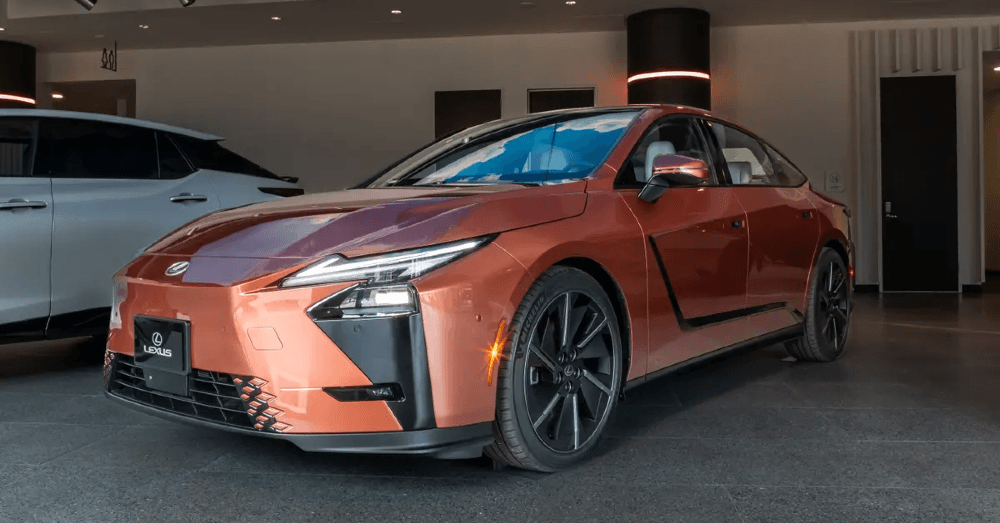
Lexus dropped pricing for its completely redesigned 2026 ES sedan, and the numbers tell an unusual story. For the first time, the all-electric model is actually the least expensive version of this popular luxury car. With a starting price of $48,795, the new ES 350e sneaks in under the $50,000 mark and costs $2,200 less than its hybrid sibling. That’s a rare move in a market where EVs almost always carry a premium over their gas-powered counterparts.
- The 2026 Lexus ES starts at $48,795 for the electric ES 350e, while the hybrid ES 350h begins at $50,995.
- The lineup drops all gas-only options and offers two EV models and one hybrid, with prices topping out above $60,000.
- Compared to luxury rivals like the BMW i5 and Mercedes-Benz EQE, the new ES undercuts them all by a wide margin.
Every 2026 Lexus ES Model and What It Costs
The cheapest model is the ES 350e Premium, which starts at $48,795, a price that includes a destination fee of $1,295. The ES 350e is front-wheel-drive only and comes in Premium or $57,195 Luxury trim levels. If you want all-wheel drive on an electric ES, you’ll have to upgrade to the dual-motor ES 500e Premium, which starts at $51,795, or the range-topping ES 500e Luxury that starts at $60,195.
On the hybrid side, the cheapest ES 350h hybrid starts at $50,995, and both trim levels of the hybrid, the base Premium and $55,795 Premium+, come standard with front-wheel drive but can be had with all-wheel drive for $1,400 more.
Gas-only trims are no longer planned. The new starting price is a big jump over what buyers currently pay for the 2025 ES, which starts at $43,215. The ES 350h Premium is comparable to the 2025 model’s ES 300h trim, which starts at $44,615, a difference of $6,380.
What Powers Each Model
The base ES 350e gets a single-motor front-wheel-drive setup with 220 horsepower, an acceleration time to 60 mph of around 7.7 seconds, and a claimed EPA range of 300 miles. That’s a solid number for a luxury sedan, and it should cover most buyers’ weekly driving needs without breaking a sweat.
The ES 500e gets a second motor at the rear axle for a total of 338 horsepower, lowering the 0-to-60 time to 5.4 seconds. Lexus estimates the ES 500e will do around 250 miles on a full charge. Both come standard with the Tesla-style NACS charge port and an 11-kW on-board AC charger. Lexus says it can go from 10% to 80% in about 30 minutes when DC fast-charging.
The hybrid ES uses a 2.5-liter inline four-cylinder engine, an ECVT, and electric motors for a combined output of 243 horsepower. Both front-wheel-drive and all-wheel-drive models produce the same power, but adding AWD drops the 0-to-60 time from 7.4 seconds to 7.2 seconds.
How the 2026 Lexus ES Pricing Stacks Up Against Rivals
One of the most interesting things about the 2026 Lexus ES pricing is how aggressively it undercuts its competition. BMW’s electric i5 will cost at least $67,100 and the base Mercedes-Benz EQE costs $64,950. The most affordable 5 Series hybrid is way up at $75,500. Even Genesis charges at least $58,450 for the non-hybrid G80, so the new Lexus ES comfortably undercuts all of them.
The ES’ price is closer to many compact sedans, and not all of them are luxury models. The mid-range Hyundai Ioniq 6 SEL costs $45,600, only a hair short of the $47,500 base ES 350e (excluding the destination charge for both). That’s a pretty wild value play for a Lexus.
A Bold New Look and a New Home
The new ES offers more interior space, thanks to a 6.5-inch longer body and a 3-inch longer wheelbase over the outgoing car. Inside, you’ll find a 12.3-inch digital gauge cluster, 14-inch infotainment touchscreen, voice assist, and wireless Apple CarPlay and Android Auto across the range. Synthetic leather upholstery comes standard, but Lexus offers upgrade packages with genuine leather and massaging, heated, and ventilated front seats.
The 2026 ES will also mark a shift in where the sedan is built. Unlike the outgoing model, which is assembled in the US, the new generation will be produced in Japan. That means the end of ES production at Toyota’s Georgetown, Kentucky, plant, where roughly 440,000 examples have been built over the past decade.
EV or Hybrid: Which One Fits Your Life?
Plenty of shoppers will have a tough time deciding between the hybrid and EV versions, since they’re so closely matched in price and performance. And like the BMW 5 Series and electric i5, the ES looks the same regardless of which powertrain you choose.
If you can live with the EV’s range and have the ability to charge at home, these models are tough to beat. If not, the hybrids are likely to feel similar behind the wheel and will be better for buyers worried about range on longer trips. With the hybrid, you’re paying a bit more up front, but you won’t need to think about charging stations or planning stops. The EV, on the other hand, gives you the lower entry price and zero tailpipe emissions.
The 2026 ES is set to arrive later this year, possibly in spring. Whether you lean toward the electric version or the hybrid, this generation of the ES looks like one of the best deals in the luxury sedan market right now.