
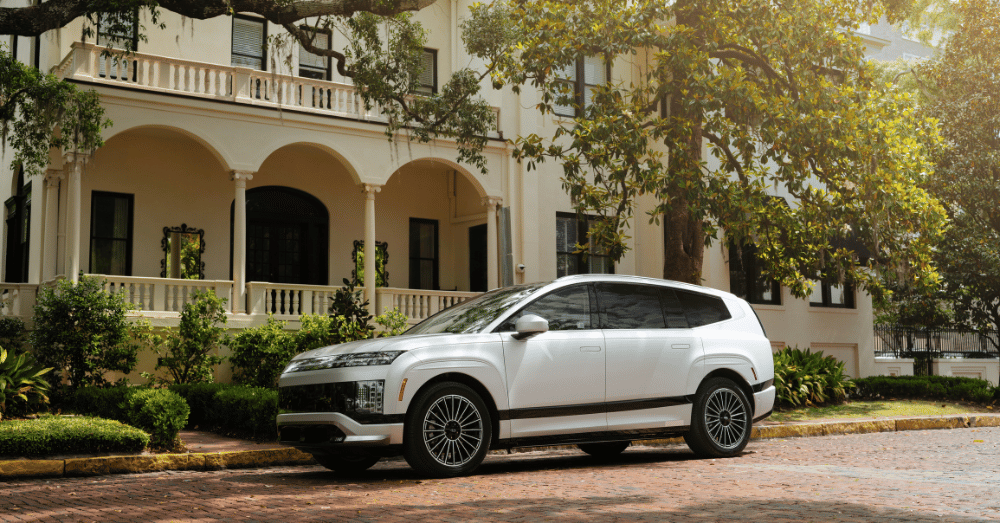
Walk through any parking lot and you’ll notice something about Hyundai’s current lineup. The boxy Santa Fe, the retro-futuristic IONIQ 5, the sleek IONIQ 6, and the compact Kona all look like they were designed by entirely different companies. That’s been intentional, but Hyundai now admits it might have gone a bit too far. The Korean automaker is working on tying its models together with a clearer family resemblance while keeping the individuality that made them stand out in the first place.
- Hyundai wants its models to share more cohesive design cues, but the company doesn’t want them to resemble a “photocopier machine.”
- The brand remains committed to head designer SangYup Lee’s “chess piece” strategy, where each model stays distinct in character.
- Early sightings of the new Bayon and Tucson suggest a chunkier, 4×4-style treatment for Hyundai’s crossovers and SUVs.
The “Chess Piece” Strategy That Started It All
Hyundai approaches its designs with a chess-like strategy. Instead of maintaining a consistent family look across the entire lineup, the brand offers a variety of designs that cater to different lifestyles and preferences, similar to the diverse chess pieces on a chessboard. Hyundai’s cars may vary in appearance, but design details like pixel lights present them as a group while maintaining their individual roles and personalities.
SangYup Lee himself described it best: “Our cars will be more like a chess board where you have a King, Queen, Bishop, Knight. They all look different and function differently but when they’re together they come as one team. This is what the Hyundai look is all about.”
The brand has been careful to make meaningful differences between its models. Lee cites the new Santa Fe and IONIQ 9 as examples. Both are three-row SUVs, but the Santa Fe went boxy to reflect current trends and maximize interior volume. The IONIQ 9, meanwhile, looks totally different. Its more rounded design maximizes aerodynamic efficiency, which matters more in an EV than in the gas-powered Santa Fe.
What’s Changing with Hyundai and Why
In a recent interview with Autocar, Hyundai Motor Europe CEO Xavier Martinet said the company wants to build a clearer visual connection between its models. He admitted that “maybe in the past, there was not this systematic sense of family between our vehicles.”
Martinet was clear about boundaries, saying “we will never do the ‘photocopier machine’ and go the other way around. We’ve seen a few brands who went maybe too far in this direction.” That last comment feels like a jab at automakers whose sedans, SUVs, and crossovers all share the same grille, the same headlight shape, and the same profile until you can’t tell a compact from a midsize without reading the badge. Whether you’re browsing new models on a lot or scrolling through used SUVs for sale online, you can usually spot which brands play the copy-paste game.
Martinet sounded enthusiastic about what’s in the pipeline, saying “I would love to show you all these cars coming; you will feel a much stronger sense of belonging to the same brand, but with the specificity of each vehicle.”

Concept Three and the Road Ahead
Martinet pointed to the bold Concept Three show car, which previews the forthcoming IONIQ 3 hatchback, as a statement of intent for Hyundai’s plan to continue using striking designs as a way to stand apart from the crowd. He recalled the reaction from its Munich debut: “When we revealed the Concept Three at Munich last year, people said: ‘Wow, finally, something different that’s not another SUV. A very strong design.'”
Hyundai’s goal is “to create something that nobody has on the market” with each new car. Pricing details will come closer to launch, but the IONIQ 3 will slot between the Kona Electric and Inster EV with prices expected around £25,000 ($33,700).
Early sightings of prototype Bayon and Tucson models suggest this new direction will show up as a chunkier, more rugged look for Hyundai’s crossovers and SUVs, building on the current Santa Fe’s character. So while each vehicle will still have its own personality, they’ll share enough DNA to feel like siblings rather than strangers.
Can Hyundai Pull Off Both Individuality and Unity?
This is the tricky part. The lack of visual similarity has actually been a selling point for Hyundai. If you don’t like the IONIQ 6’s styling, maybe you’ll like the IONIQ 5 or the Kona, all of which are different enough to appeal to separate tastes. Compare that to some brands where disliking one model’s look means disliking most of the lineup.
Over the last decade, Hyundai has turned into one of the most talked-about names in automotive design, and much of that credit goes to SangYup Lee, who joined Hyundai as design chief in 2016. Lee’s work on the IONIQ 5 alone earned World Car of the Year, World Electric Vehicle of the Year, and World Car Design of the Year honors. His track record suggests the brand knows how to balance bold moves with crowd appeal.
The approach sounds promising on paper. Shared design DNA through pixel lighting, consistent proportional themes, and a recognizable “Hyundai” feeling without turning every model into a resized version of the same car. If the upcoming Tucson and Bayon prototypes are any indication, Hyundai is aiming for family ties, not family uniforms. And given how well the brand has handled design risks so far, there’s good reason to believe they’ll get it right.