
Electric pickups are finally proving they can haul serious weight, but there’s still a big gap between what the brochures promise and what happens when you hook up a trailer. The race is on to see which truck maker can crack the towing code first.
- New electric trucks can tow up to 12,500 pounds – matching most gas trucks
- Real-world tests show you lose about half your driving range when towing heavy loads
- The winners in this space will be the companies that solve both capacity and efficiency problems
Remember when people laughed at the idea of electric trucks doing real work? Those days are over. Walk around any truck lot today and you’ll see EVs with towing specs that would make a diesel driver do a double-take.
The GMC Hummer EV can pull 12,000 pounds. The Chevy Silverado EV Work Truck ups that to 12,500. Ford’s Lightning hits 10,000 when you tick the right boxes, and Rivian’s R1T claims 11,000. These aren’t golf cart numbers – they’re legitimate truck specs.
But here’s where it gets tricky. Anyone can slap a big number on a spec sheet. The question everyone’s asking is: how far can you actually go when you’ve got 10,000 pounds dragging behind you?
The Reality of Range
Consumer Reports took a Ford Lightning and Rivian R1T out for some serious testing, hooking both up to a 10,000-pound trailer. The results? Both trucks barely made it 85 miles before running low on juice. That’s about what you’d get from a Nissan Leaf on a good day.
Car and Driver did their own test with three different electric trucks pulling a 6,100-pound camper. Same story – all three lost about half their range. The Hummer actually did best, probably because it’s already such a brick that adding a trailer didn’t make the aerodynamics much worse.
Even Tesla’s much-hyped Cybertruck falls into the same pattern. Real-world testing with a 3,250-pound camper yielded just 160 miles of range. That’s not even close to the 340+ miles Tesla claims for highway driving without a trailer.
The math is pretty consistent across all these trucks: hook up a heavy trailer and you’re looking at roughly half the range you’d get driving solo.
Why This Battle Matters So Much
Truck buyers aren’t messing around when it comes to towing. These are people who need to haul boats to the lake, pull campers across state lines, or move construction equipment between job sites. For them, towing capacity isn’t a nice-to-have feature – it’s the whole point of owning a truck.
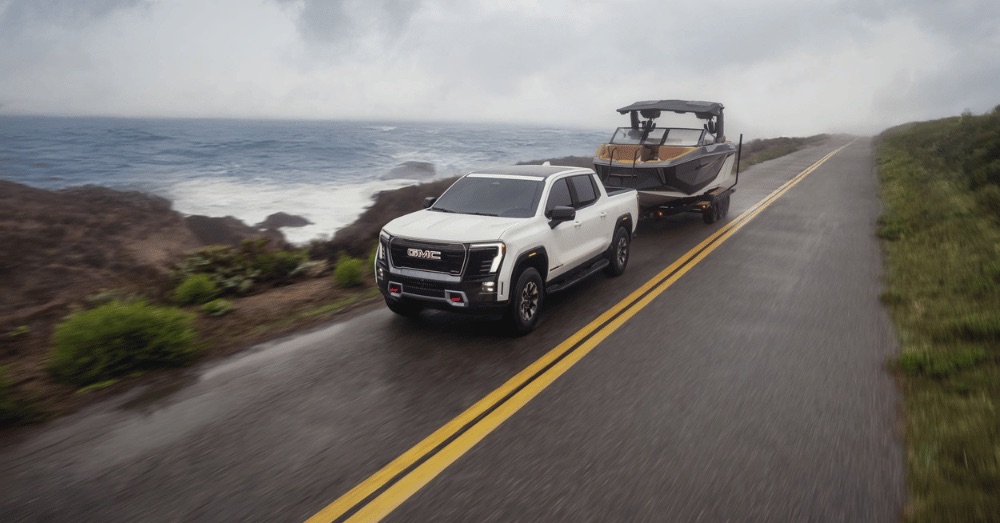
GMC electric vehicles and other manufacturers get this. That’s why the 2025 Sierra EV can tow up to 10,500 pounds while still claiming 460 miles of range when empty. Those are competitive numbers on paper.
The problem is that “on paper” and “in your driveway with a boat trailer” are two very different things.
The Engineering Challenge
Here’s what makes towing so tough for electric trucks: batteries are heavy, trailers create drag, and physics doesn’t care about your marketing department’s promises.
Some manufacturers are trying different approaches. Tesla focuses on super-fast charging; their Cybertruck can add 94 miles of range in 15 minutes. The idea is that even if your range sucks while towing, you can top up quickly enough that it doesn’t matter.
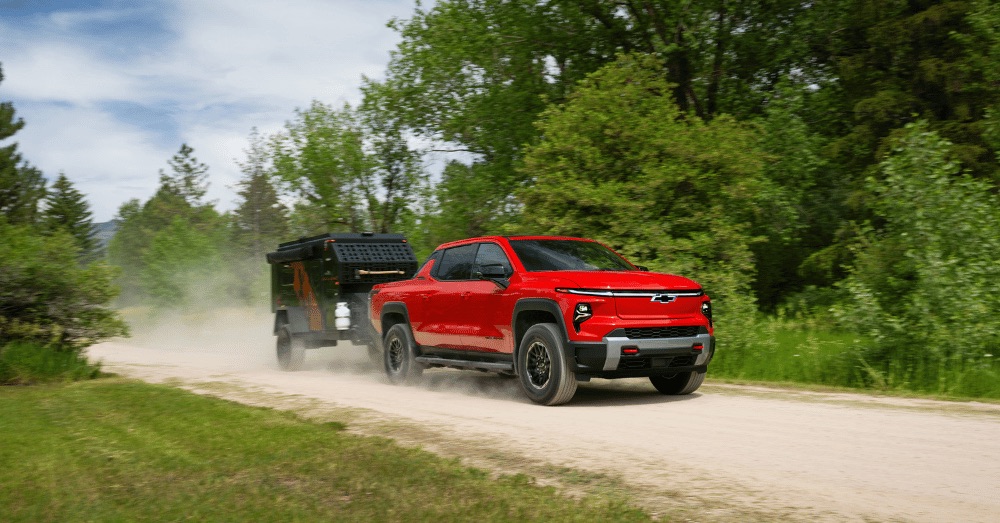
Others are throwing bigger batteries at the problem. The Chevy Silverado EV has a massive 200+ kWh battery pack. In recent testing, one managed to tow a 6,500-pound trailer for 232 miles before needing a charge. Not amazing, but respectable.
GM is betting that their air suspension and four-wheel steering will make the towing experience smooth enough that people won’t mind the range hit. Meanwhile, Ram keeps promising their upcoming 1500 REV will “outperform every other full-size truck,” though they haven’t backed that up with actual numbers yet.
Real Owner Experiences
One GMC Sierra EV owner recently shared his experience towing a 9,000-pound boat through Nova Scotia. He used 25% of his battery for about 50 miles of towing, which works out to roughly 200 miles of total towing range. Not terrible, but nowhere near the 400+ miles you’d get driving without a trailer.
What’s interesting is that weight seems to matter less than wind resistance. Ford Lightning owners report similar range whether they’re towing 3,000 pounds or 7,000 pounds, as long as the trailers have similar shapes. A low-profile boat trailer might give you better range than a tall, boxy camper even if the boat weighs more.
What’s Coming Next
The next few years are going to be wild for electric truck towing. Battery technology keeps getting better, and manufacturers are designing new trucks specifically for hauling rather than converting existing platforms.
Charging infrastructure is expanding too, with more stations that can actually accommodate a truck with a trailer attached. Tesla’s opening up their Supercharger network, which could be a game-changer for non-Tesla EVs.
Some companies are exploring hybrid approaches. Ram’s upcoming Ramcharger uses a gas engine as a generator to keep the batteries topped up, potentially solving the range problem entirely.
The Bottom Line
Electric trucks can absolutely tow heavy loads – the torque delivery is actually smoother and more controlled than gas engines. The challenge is doing it for more than 100-200 miles without stopping.
For local work and weekend trips within a couple hours of home, today’s electric trucks are already pretty compelling. The instant power, quiet operation, and lack of exhaust fumes make for a pleasant towing experience.
For cross-country adventures with a big camper? You’re still better off with diesel, at least for now. But given how fast this technology is moving, that might not be true much longer.
The manufacturers who figure out how to deliver both high towing capacity and reasonable range are going to own this market. Right now, it’s anyone’s game.