
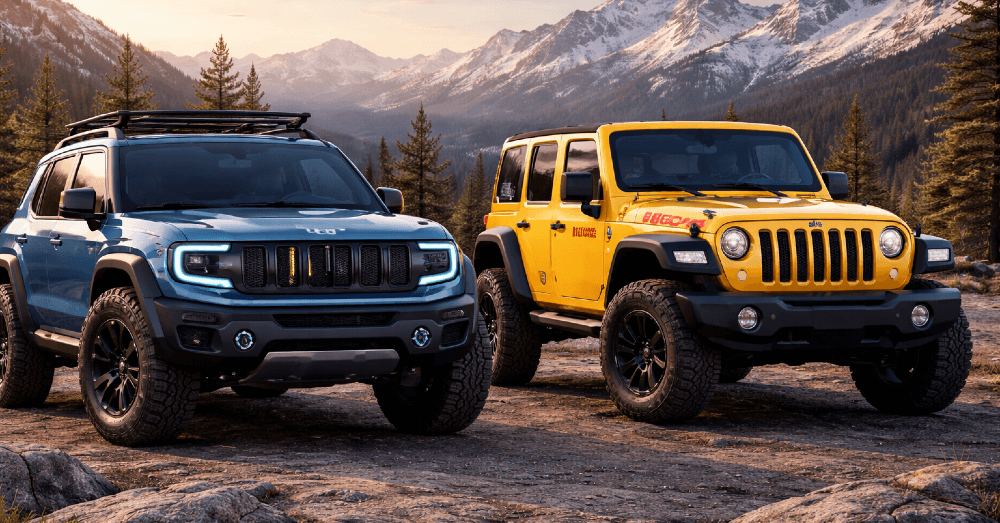
Jeep now has two very different paths to open-air, trail-ready fun. The 2026 Recon brings 650 horsepower of electric muscle to the table, while the tried-and-true Wrangler keeps doing what it’s done for decades with solid axles, a body-on-frame setup, and gasoline power. Both wear that famous seven-slot grille, both let you rip the doors off, and both carry the Trail Rated badge. So which one actually fits your life? Let’s get into it.
- The all-electric 2026 Recon uses dual electric motors rated at 650 horsepower and 620 pound-feet of torque, paired with a 94-kWh battery and standard four-wheel drive.
- The 2026 Wrangler offers a 285-horsepower V6, a 270-horsepower turbo four-cylinder, or a 470-horsepower V8, with both manual and automatic transmissions available.
- Both share a boxy silhouette, removable doors, and a rear-mounted spare tire, but the Recon uses a unibody STLA Large platform with independent suspension, while the Wrangler sticks to a body-on-frame layout with solid axles.
Power and Drivetrain Differences
This is where the two SUVs couldn’t be further apart. The Recon’s dual electric motors produce 650 horsepower and can launch it from 0 to 60 mph in 3.6 seconds. All that torque hits the wheels instantly, which is a real advantage for both highway merging and low-speed rock crawling. The Recon gets a different 15:1 final drive ratio on the rear motor, designed to help with low-speed crawling since it doesn’t offer a dedicated low-range four-wheel drive system.
The Wrangler comes with three engine choices: a 285-horsepower V6, a 270-horsepower turbocharged four-cylinder, or a 470-horsepower V8, paired with either a six-speed manual or an eight-speed automatic. Its 4×4 system includes part-time four-wheel drive with 2H/4H/4L transfer case modes, plus locking differentials and an electronic sway-bar disconnect on the Rubicon. That traditional low-range gearing is something Wrangler loyalists swear by.
The Recon has an estimated range of up to 250 miles and can charge from 5% to 80% in about 28 minutes on a DC fast charger. Meanwhile, the gas-powered Wrangler gets up to 20 mpg city and 23 mpg highway with the turbo four-cylinder, while the V6 with the manual lands at 17 city and 23 highway. You’ll never wait for a charge in a gas Wrangler, but you’ll be visiting the pump often.
Off-Road Capability and Design
Jeep is proud to proclaim the Recon is the first EV to earn the Trail Rated badge. Even so, the two SUVs tackle trails in very different ways. The Recon uses a unibody platform with independent suspension, which gives it a smoother on-road ride but changes the off-road dynamic compared to the Wrangler’s body-on-frame construction and solid axles.
The Recon uses fixed-height coil springs and offers 9.1 inches of ground clearance. It can ford up to 24 inches of water and has trail-tailored bumper designs that improve its approach and departure angles. For context, the Wrangler and Ford Bronco offer approach and departure angles in the 40-degree range, while the Recon sits a tier below with geometry closer to the Mercedes G-Class and Toyota Land Cruiser.
The Wrangler Rubicon, built for hardcore off-roaders, features a sturdier transfer case, heavy-duty front and rear axles with locking differentials, disconnecting anti-roll bars, and 33-inch all-terrain tires, plus rock rails to protect against damage. If you’re planning to spend weekends crawling the Rubicon Trail, the Wrangler still has the edge in pure rock-crawling ability.
Open-Air Freedom and Interior Tech
Both of these SUVs let you tear them apart for a wind-in-your-hair experience. The Wrangler has been updated for 2026 to allow tool-free door removal, catching up to the Recon. You can also remove parts or all of the Wrangler’s top, with removable hardtop roof panels and a standard soft top that pulls back and stows.
The Recon takes a slightly different approach, with a standard panoramic glass roof and an available power Sky roof, plus removable rear-quarter and tailgate glass, all tool-free. One big difference: the Wrangler’s windshield folds down for trail use, while the Recon’s windshield is fixed.
Inside, the Recon is clearly the more modern cabin. It comes standard with a 12.3-inch digital instrument cluster, a 14.5-inch Uconnect 5 touchscreen with navigation, Alpine premium audio, wireless charging, heated front seats, and power-adjustable seats with memory. The Wrangler keeps things simpler, with a 12.3-inch touchscreen, wireless Apple CarPlay and Android Auto, Bluetooth, and an eight-speaker audio system. The Recon also has a packaging advantage at about 5 inches longer and an inch wider than the Wrangler, giving it 2.8 inches more shoulder room and 7.6 cubic feet more passenger volume.
Picking the Right Jeep for Your Budget and Your Trail
Any 2026 Jeep Recon vs Jeep Wrangler specs comparison really comes down to how you plan to use your Jeep. The Recon starts at $66,995, while the Wrangler starts at $36,890 including destination. That’s a massive price gap at the entry level, though the comparison tightens when you look at higher Wrangler trims. The gas-powered Wrangler ranges from the Sport all the way up to the Moab 392, with pricing from $36,890 to $81,990.
If you want raw, traditional off-road ability with proven solid-axle hardware, a manual transmission option, and a lower starting price, the Wrangler is still the one. The Recon launches in the Moab trim, which comes loaded with off-roading hardware, and it’s a genuinely exciting choice for anyone who wants instant electric torque, a quieter ride, and a more tech-filled cabin on and off the trail. With its open-air vibes and lifestyle appeal, the Recon may well pull some buyers away from the Wrangler across the gas-electric divide.